

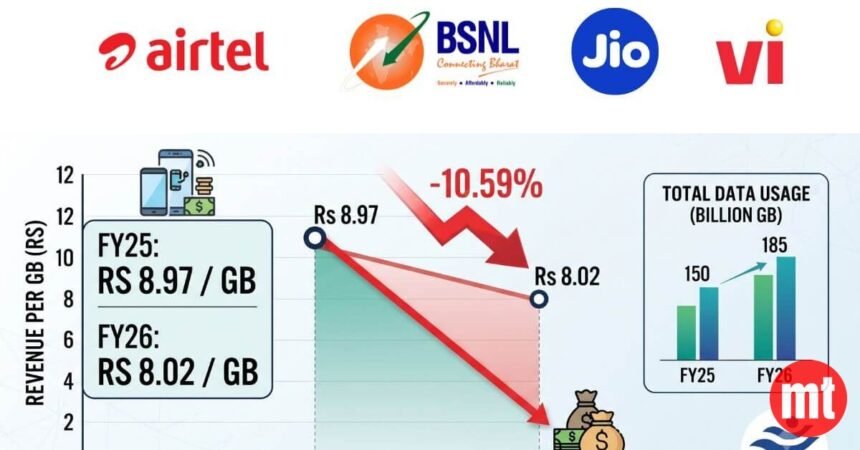
TRAI‘s FY2026 performance data confirms wireless data revenue India has slid sharply, with average revenue per GB of wireless data falling 10.59 percent to Rs 8.02 from Rs 8.97 in the previous fiscal year. The figures, published in TRAI’s latest subscriber and performance report, cover all licensed telecom service areas and apply directly to Reliance Jio, Bharti Airtel, Vodafone Idea, and BSNL as the principal wireless data carriers operating across India.
Policy Summary: wireless data revenue India
- Issued by: Telecom Regulatory Authority of India (TRAI)
- Effective: Data covers full fiscal year ending March 31, 2026
- Affects: Reliance Jio, Bharti Airtel, Vodafone Idea, BSNL and all licensed wireless data providers
- Core mandate: TRAI requires all operators to report per-GB revenue realization quarterly for tariff monitoring and consumer protection benchmarking
In This Article
What the wireless data revenue India Directive Actually Requires
TRAI’s mandatory reporting framework requires every wireless carrier to submit granular revenue-per-GB data as part of its periodic performance indicators. Wireless data revenue India figures are then aggregated and published by TRAI to enable tariff surveillance. The FY2026 report shows that operators collectively earned Rs 8.02 per GB across all wireless data consumed nationally, a figure TRAI uses as the baseline when assessing whether retail tariff bundles deliver fair value to subscribers.
No operator-specific exemptions exist under the current reporting circular. TRAI has not announced a grace period for data submission compliance, and operators that miss quarterly filing deadlines face financial penalties under the TRAI Act, 1997. One area of interpretive ambiguity remains: the regulator has not yet clarified whether revenue from fixed-wireless-access services bundled with mobile plans should be counted separately or folded into the wireless per-GB average from FY2027 onward.

Industry Impact: Winners and Losers Under wireless data revenue India
A declining per-GB realization rate cuts both ways. For Reliance Jio, which commands the largest data subscriber base and benefits from the lowest cost-per-GB infrastructure, the compression is manageable. Airtel’s premium postpaid strategy partially insulates it, since higher-ARPU customers consume less data relative to their plan spend. Vodafone Idea carries the most risk: its subscriber base continues to shrink, meaning wireless data revenue India trends compound its cash-flow pressure at a time when the company is still executing a critical network capex programme.
“The Rs 8 per GB floor is not a regulatory price cap, but when TRAI publishes this number, it signals to the market that further tariff cuts will attract scrutiny. Operators need room to invest in 5G backhaul, and single-digit per-GB revenue does not give them that room.” — Telecom Industry Analyst
Why Is Falling Wireless Data Revenue India a Problem for 5G Expansion?
Per-GB revenue compression directly limits the capital available for 5G spectrum payments and radio access network upgrades. TRAI’s FY2026 data shows wireless data revenue India at its lowest recorded per-GB level, arriving precisely as operators must service Rs 5G spectrum auction debt from the 2026 and 2026 rounds. Analysts at brokerage firms including Motilal Oswal have flagged that another 10 percent decline in FY2027 would push average per-GB realization below Rs 7.20, a threshold that could trigger fresh tariff revision petitions to TRAI before December 2026.
Compliance Timeline and What Happens Next With wireless data revenue India
TRAI publishes performance indicator reports on a quarterly basis, and operators must submit underlying data within 45 days of each quarter’s close. The next filing cycle covering Q1 FY2027 falls due by mid-August 2026. Industry bodies including the Cellular Operators Association of India have not yet filed any formal representation challenging the current per-GB reporting methodology. Observers expect TRAI to release a consultation paper on data tariff adequacy before the end of the calendar year, which could set new reference benchmarks for wireless data revenue India across all service areas.
Sources: Ericsson ↗ | GSMA ↗ | COAI ↗ TRAI Telecom Subscription Data and Performance Indicators Report, FY2026; TelecomTalk.info (https://telecomtalk.info/revenue-per-gb-data-drops-fy26-trai/1012551/); TRAI Act, 1997; Motilal Oswal Telecom Sector Research, 2026.
People Also Ask
- What is the current wireless data revenue India per GB rate in FY2026? TRAI’s FY2026 report places average revenue realization at Rs 8.02 per GB of wireless data consumed across India, a 10.59 percent decline from Rs 8.97 per GB recorded in the previous fiscal year.
- Which telecom operator is most affected by falling wireless data revenue India? Vodafone Idea faces the greatest pressure. Its shrinking subscriber base and ongoing network capex requirements mean lower per-GB realization compounds existing cash-flow and debt-servicing challenges more acutely than it does for Jio or Airtel.
- Will TRAI intervene to protect wireless data revenue India from further decline? TRAI is expected to release a consultation paper on tariff adequacy before end-2026. Any formal floor-price mechanism would require a new regulatory order, which operators or consumer groups could separately challenge before the Telecom Disputes Settlement and Appellate Tribunal.