


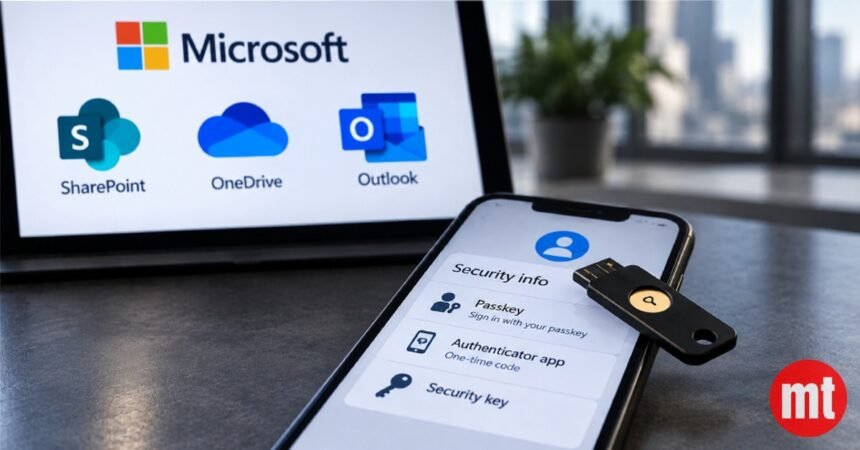
Passkey phishing Microsoft accounts is no longer a theoretical threat — two active campaigns disclosed by Microsoft in September 2026 confirm attackers are weaponising passkey-themed social engineering to break into cloud environments and steal sensitive data. Over one million scam emails hit inboxes between August 3 and 5, 2026 alone. Security teams across enterprises need to act right now.
What You Need To Know
- Over 1 million fraudulent emails sent in just three days (August 3–5, 2026)
- Attackers impersonated CEOs to trick employees into fake passkey authentication flows
- Third-party email delivery infrastructure was abused to bypass spam filters at scale
- Cloud data exfiltration confirmed in breached Microsoft 365 environments
How Passkey Phishing Microsoft Accounts Became a Live Attack Vector
Microsoft’s threat intelligence team published its findings in September 2026, revealing two distinct but coordinated campaigns. The first used third-party email delivery platforms to blast financial fraud messages while masquerading as chief executive officers. The second deployed passkey-themed social engineering pages designed to harvest credentials and session tokens from Microsoft 365 cloud environments. Once inside, threat actors moved fast, exfiltrating data before security tools could flag anomalous behaviour. Both campaigns share infrastructure overlap, suggesting a single organised threat group.

Why Indian Enterprises Cannot Ignore This Warning
Indian corporations running Microsoft 365 workloads, including firms like Infosys, Wipro, and thousands of mid-market BFSI players, sit squarely in the crosshairs of passkey phishing Microsoft accounts attacks. India added over 11 million Microsoft 365 business seats in 2026 according to IDC estimates, making it one of the fastest-growing Azure Active Directory markets globally. Attackers specifically target high-volume markets where IT security maturity varies sharply between large enterprises and smaller vendors in their supply chains.
The financial fraud angle amplifies the risk considerably. CEO impersonation emails convincing finance teams to approve wire transfers or share credentials are already a top-three cyber threat reported to CERT-In in 2026. When attackers layer passkey-themed lures on top of that, even moderately tech-savvy employees can be fooled. A compromised cloud account in a mid-sized Indian IT services firm can cascade into client data breaches, regulatory penalties under the Digital Personal Data Protection Act, and reputational damage that takes years to repair.
“Passkey adoption without employee education is a false sense of security. Attackers are now engineering fake passkey flows that look indistinguishable from legitimate prompts. Enterprises need conditional access policies, phishing-resistant MFA, and regular red-team simulations, not just awareness emails.” — Cybersecurity Director, Enterprise Telecom Sector
What Security Teams Must Do Before the Next Wave Hits
Microsoft has urged all cloud tenants to audit third-party email connectors immediately, revoke suspicious OAuth app permissions, and enforce phishing-resistant FIDO2 keys rather than software-based passkeys alone. The threat of passkey phishing Microsoft accounts grows more acute as adoption of passwordless authentication accelerates across Indian enterprises through 2026. Security operations centres should prioritise alert rules for abnormal token issuance and bulk email activity originating from unfamiliar sending domains tied to legitimate email infrastructure providers.
Sources: DOT ↗ | TRAI ↗ | COAI ↗ The Hacker News, September 2026; Microsoft Threat Intelligence Blog, September 2026; IDC India Cloud Adoption Report, 2026; CERT-In Quarterly Advisory, Q2 2026.
People Also Ask
- What is passkey phishing and how does it compromise Microsoft accounts? Passkey phishing tricks users into entering credentials or approving authentication requests on fake pages designed to mimic legitimate Microsoft passkey prompts, giving attackers session tokens that grant full access to cloud accounts without needing a password.
- How did attackers send over a million emails without getting blocked by spam filters? The threat group abused legitimate third-party email delivery platforms, routing malicious messages through trusted infrastructure that most enterprise spam filters whitelist by default, allowing the campaign to evade detection at massive scale.
- How can organisations protect Microsoft 365 accounts from passkey phishing attacks? Enforce hardware-backed FIDO2 security keys, audit all third-party OAuth app permissions regularly, enable Microsoft Conditional Access policies, and conduct phishing simulation exercises that specifically include passkey-themed lure scenarios for all staff.