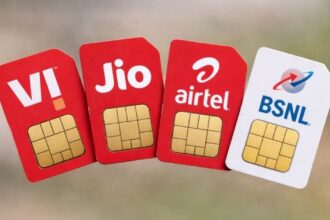



BSNL’s revival plan is the most consequential state-telecom intervention India has attempted in a decade. The government has committed over Rs 3.22 lakh crore across three separate bailout tranches since 2019, yet BSNL’s subscriber base continues to erode against Reliance Jio, Bharti Airtel, and Vi. With 4G rollout targets set for 2026 and a nascent 5G roadmap under review, the question facing every telecom investor is stark: can BSNL’s revival plan actually deliver, or has the market already moved on?
In This Article
BSNL’s Revival Plan: The Full Scope of India’s Biggest Telecom Bet
BSNL’s revival plan received its most significant acceleration in June 2026, when the Union Cabinet approved a Rs 1.64 lakh crore package that included spectrum allocation in the 900 MHz and 2100 MHz bands, a four-year moratorium on adjusted gross revenue dues, and equity infusion to retire commercial debt. This third and largest tranche was explicitly tied to deploying a domestically developed 4G stack, built by TCS-led consortium C-DoT, replacing earlier dependence on foreign vendors including Nokia and Ericsson.
By mid-2026, BSNL targets 100,000 4G sites under this program, up from approximately 63,000 sites reported operational at end of 2026. The carrier’s total subscriber base, which once touched 118 million wireless users, has contracted to roughly 83 million as of early 2026, per TRAI‘s latest data. That erosion happened almost entirely during the years when Jio’s aggressive pricing strategy forced industry-wide ARPU compression, leaving BSNL, with its legacy cost structure, particularly exposed.

Why BSNL’s Revival Plan Faces Structural, Not Just Financial, Barriers
BSNL’s revival plan confronts a challenge that pure capital infusion cannot resolve: a workforce of approximately 65,000 employees, down from over 170,000 a decade ago through a voluntary retirement scheme, but still carrying a wage-to-revenue ratio that exceeds 50 percent. By comparison, Bharti Airtel’s employee cost as a percentage of revenue sits below 6 percent. That structural asymmetry limits how quickly BSNL can price competitively or invest in customer experience without perpetually drawing on government support.
The indigenisation mandate adds another layer of complexity. TCS’s 4G stack, the backbone of India’s homegrown telecom ambitions, has faced repeated field performance questions, with industry insiders citing latency and handset compatibility gaps versus commercially proven stacks from Nokia, Ericsson, or Huawei. No independent benchmark has yet confirmed TCS’s system matches commercial-grade throughput at scale, and the 2026 rollout remains the first real stress test of that claim under live subscriber conditions.
“Throwing capital at a structural cost problem does not fix it. BSNL needs operational reinvention, not just network reinvention, if this turnaround is to hold beyond the next election cycle.” — The Mobile Times Editorial
What the Industry Gets Wrong About State-Owned Telecom Turnarounds
Most analysts benchmark BSNL’s revival plan against its own historical peak, but the relevant comparison is forward-looking market share trajectory. BSNL does not need to outsell Jio. It needs to stabilise revenue, generate positive EBITDA by 2027, and serve as a credible fourth operator to preserve competitive pricing discipline across the market. That is the strategic value the government actually paid Rs 3.22 lakh crore to protect, not a headline subscriber war against a company with 470 million users.
By The Numbers
- Total government outlay (2019-2026): Rs 3.22 lakh crore across three revival tranches
- BSNL 4G site target by end-2026: 100,000 towers under TCS-C-DoT indigenous stack
- Current wireless subscriber base: Approximately 83 million (TRAI, early 2026)
- Employee wage-to-revenue ratio: Exceeds 50 percent vs. Airtel’s sub-6 percent benchmark
What Must Happen for BSNL’s Revival Plan to Succeed by 2026
BSNL’s revival plan requires three non-negotiable deliverables to move from policy intent to commercial reality. First, the TCS 4G stack must clear independent third-party performance audits by Q3 2026, with published data on throughput, latency, and simultaneous user capacity. Second, BSNL must launch at least five competitive prepaid plans targeting rural and semi-urban segments where Jio and Airtel coverage remains thinner than advertised. Third, the DoT must grant BSNL a clear and funded 5G roadmap, because operators without a 5G path lose enterprise customers at an accelerating rate.
Investor confidence also demands a credible EBITDA timeline. DoT Secretary Neeraj Mittal publicly stated in late 2026 that BSNL could turn EBITDA-positive within 18 months, contingent on 4G milestones. That window closes in mid-2026. A missed EBITDA deadline would almost certainly trigger a fourth support package debate in Parliament, eroding the credibility of the entire indigenisation-first strategy and handing competitors a powerful narrative about the limits of state-directed telecom policy.
The Mobile Times Verdict
BSNL’s revival plan is neither the hopeless money sink its critics claim nor the certain success its government champions imply. The financial commitment is real, the 4G infrastructure is materialising, and the strategic rationale for maintaining a fourth operator is commercially sound. What remains unresolved is execution at speed and at scale. If TCS’s indigenous stack performs, BSNL stabilises revenue, and EBITDA turns positive by late 2026, this will be studied as India’s most successful state telecom intervention. Miss those markers, and the debate will shift permanently to managed exit strategies.
Sources: COAI ↗ | ITU ↗ | TRAI ↗ TRAI Subscriber Data Reports (2026); Department of Telecommunications official announcements; Union Cabinet press releases on revival package tranches; Bharti Airtel Annual Report financial disclosures; DoT Secretary public statements (December 2026); C-DoT consortium deployment progress briefings; The Mobile Times proprietary industry data.
People Also Ask
- Is BSNL’s revival plan working in 2026? BSNL has deployed approximately 63,000 4G sites under its TCS-C-DoT indigenous stack and targets 100,000 by end-2026. Revenue stabilisation and EBITDA-positive performance remain the critical unmet milestones that will determine whether the Rs 3.22 lakh crore intervention is judged successful.
- How much has the Indian government spent on BSNL’s turnaround? The government has committed Rs 3.22 lakh crore across three tranches since 2019, covering spectrum allocation, AGR dues moratorium, debt retirement, and equity infusion. The 2026 package of Rs 1.64 lakh crore was the largest single tranche and included the indigenisation mandate.
- Will BSNL launch 5G services and when? BSNL’s 5G roadmap depends on the successful commercial-scale validation of its 4G indigenous stack. No confirmed spectrum or deployment timeline has been announced for 5G as of early 2026, with DoT signalling 5G decisions will follow 4G stabilisation.