


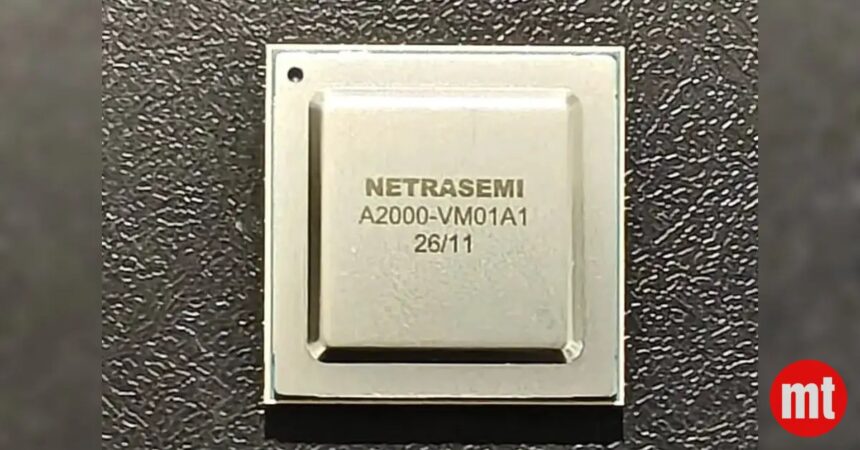
Kerala-based chip startup Netrasemi has launched the A2000, its first edge AI system-on-chip, built on TSMC’s 12nm process, and has started early customer trials.
The company declared the chip production-ready in May 2026, which is its own claim. Reports point to commercial production around 2027. Zoho and Unicorn India Ventures are among its investors. Details are based on NewsBytes and Aviation Defence Universe.
Netrasemi A2000 at a glance
| Item | Details |
|---|---|
| Type | Edge AI system-on-chip |
| Process | TSMC 12nm |
| Target uses | Smart cameras, drones, robotics, industrial automation |
| Status | Early customer trials |
| Expected | Commercial production by about 2027 |
Funding is reported differently, from ₹107 crore to ₹125 crore.
Why it matters
Edge AI means running AI on the device itself, not in a distant data centre. That helps cameras and machines respond quickly, with less data sent over the network. Netrasemi is a fabless company: it designs the chip, and TSMC makes it.
An Indian startup getting a chip to this stage is notable, but trials and commercial sales are different things. We have seen no independent test of the chip so far.
Netrasemi is part of a wider push to make chips in India. Micron plans to assemble and test hundreds of millions of chips at Sanand next year, Tata Electronics has partnered with Nexperia for chip manufacturing at Dholera and Jagiroad, and Seoul Semiconductor has held early talks with states about a plant. Our explainer on India’s AI policy covers the IndiaAI Mission.
Netrasemi is running early trials of the A2000 with three customers in the surveillance and automotive sectors, plans mass production at TSMC in Taiwan in 2027 and is targeting a commercial launch in mid-2027, The Ascendants reported. The company is also working on the R1000, a chip for IoT sensors developed with the College of Engineering Trivandrum under MeitY’s Chip-to-Startup programme, and the A4000, an edge AI server chip it expects to be ready for fabrication by the second quarter of 2027.
Why it matters to the trade
This chip is for cameras and industrial devices, not phones, so nothing changes in shops. It is a sign of India’s growing chip design work.