

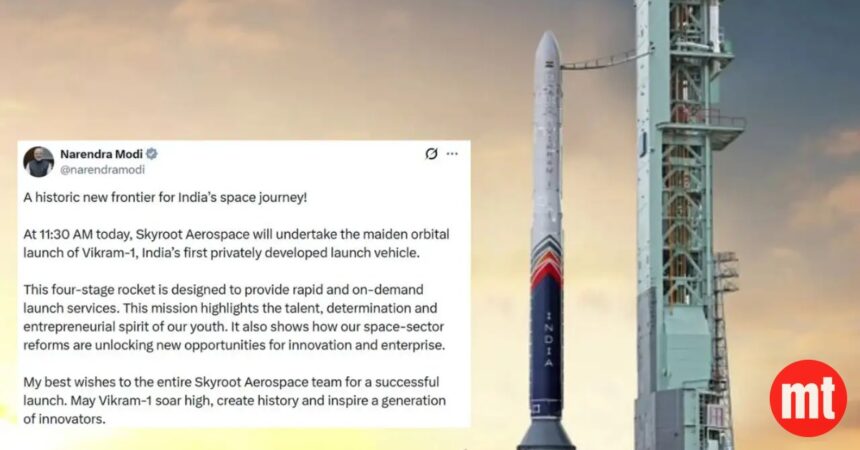
Skyroot Aerospace’s Vikram-1 reached orbit on July 18, 2026, becoming India’s first privately developed orbital rocket.
The mission, named Aagaman, lifted off from Sriharikota at 12:05 pm IST, about 35 minutes after its scheduled time, and placed its payloads in an orbit of about 450 km. Details are based on Business Today, ETV Bharat and Starlust.
What happens next
Skyroot has said it plans a second test flight before starting commercial launches. The second flight will use the same vehicle configuration, with improvements based on data from the maiden mission, and Skyroot aims to begin commercial launches in early 2027, Business Standard reported on October 30.
The first-stage hardware for the next Vikram-1 has been shipped to Sriharikota, where integration and testing are under way, and the company is targeting the second flight around December 2026 or early January 2027, Startuppedia reported after Skyroot tested its Raman-1 thruster. Skyroot has indicated that fully commercial launches will start from the third mission.
Why it matters
India is now the third country, after the United States and China, where private companies have carried out orbital launches. Skyroot’s earlier Vikram-S suborbital flight in November 2022 was the first privately built Indian rocket to reach space.
Satellites matter to telecom as well. BSNL has held early talks with Starlink, and our 5G guide covers where satellite internet stands in India.
Correction (October 26, 2026): This article was first written before the launch. It has been updated with the mission result, and a duplicate post has been merged into it.